

User Research on Increasing People's Awareness
of Feeding America during COVID-19
Team Member
ChingYa Wang,
Kelsey Listrom,
Bahar Bokharaee
Overview
This research attempts to develop an understanding of awareness of Feeding America for people who may be food insecure during the COVID-19 outbreak. We conducted online interviews with six participants who were either unaware of Feeding America or currently aware of their food support services. Through an in-depth analysis of the interview data, we tried to bridge the information gap that might exist among those two populations.
Ultimately, the outcomes of the research assisted Feeding America to meet the needs of food-insecure individuals, open up new channels of communication that previously were not used by them, and improve the potential member experiences of using Feeding America's services.
Type
Team Research Project
Skills
User Research
Ethnographic Qualitative Research
Role
User Researcher
Team Collaborator
Duration
10 weeks
(Mar - Jun 2020)

Tool
Background
As a nonprofit organization, Feeding America is a nationwide network of more than 200 food banks across the United States that feed more than 46 million people through food pantries, soup kitchens, shelters, and other community-based agencies. As reported by Feeding America (2020), most low wage jobs have been impacted by COVID-19 leaving many people out of work, particularly those in the service, leisure, and hospitality industries. The recent surge in unemployment, could signal an increase in the need and usage of food bank services.

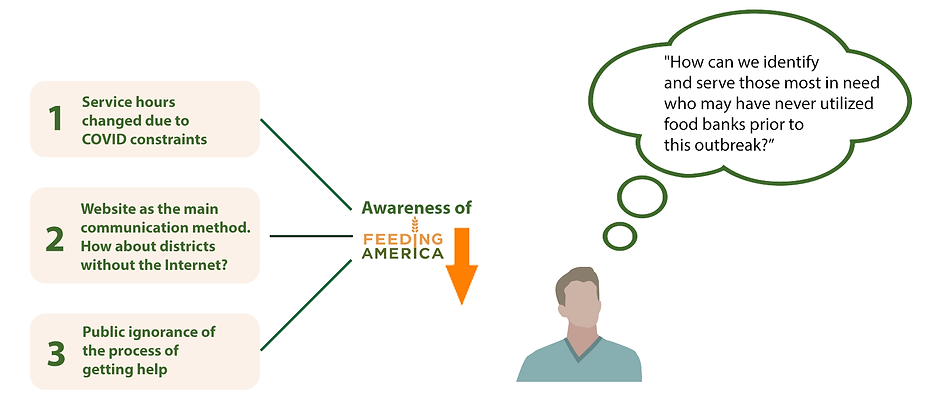
With the COVID-19 outbreak, Feeding America has adapted its outreach and strategies to provide services to food insecure populations such as through mobile pantries and “backpack” meal to-go programs for families and children. However, some communication breakdowns as below could cause a decrease in people's awareness and usage of Feeding America.
Objectives
1. Understand the issue of food insecurity and awareness from the point of view of people in need.
2. Understand people’s perception of food banks and the requirements for eligibility.
Research Questions

-
Are people who may be food insecure because of losing their jobs during COVID-19 aware that they might be eligible for food services provided?
-
If they already know about it, why are they not members?
-
What are their thoughts on receiving help of this kind?
-
Are there any barriers that keep them from accessing this help?
-
If they are not aware, how could Feeding America make them aware?
Methodology
In order to look for potential audience, we posted ads on Facebook, distributed flyers in a food bank, and asked from our friends and relatives. We created a screener question survey to ensure that the individuals meet our requirements. In the end, we recruited six participants who represent users from our targeted sample population; three of them had used food banks before, and three of them never have used food banks services. Our team conducted synchronous online interviews virtually through Zoom or by phone, for those without internet access.
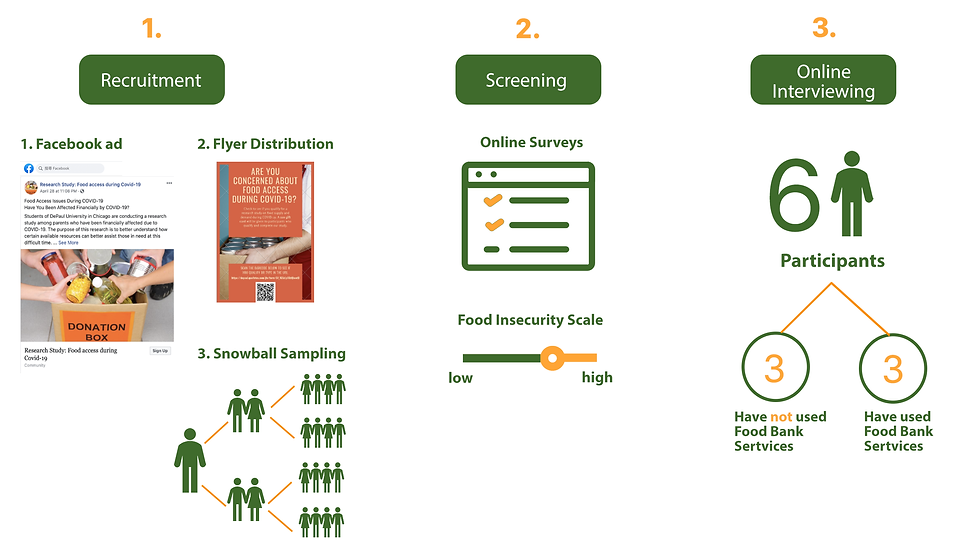
Then, we transcribed, coded, and created the affinity diagram using Stormboard to analyze and synthesize our data obtained from the interviews. We discussed the "why" behind each thought in order to figure out the critical themes, meaningful categories, and their connections.

Interesting Findings from the Research
1. No One is Immune to the Challenges of COVID-19
Users and Non-Users had many similarities of how COVID-19 affected them, including feelings of isolation, fears of exposing themselves to the virus, and uncertain food plans.
2. Food Insecurity Means Different Things to Different People
We found that the definition of food insecurity is influential to people’s awareness of food support systems.

3. Familiarity and Trust Are Essential for Getting People On Board
People prefer to get help from people they know because there is a level of comfort and a strong connection by going to family and friends first. They would reach out for help from government resources and non-profit organizations as their second choice.
4. Increased Media Attention Around the Issue Has Helped
People Most participants cited that technology is a way to access information so they could be more aware of food support services by searching online. For people who have used food support services, they noticed an increase in advertisement since COVID-19. Some said they know Feeding America through volunteering systems and health care professionals.
5. Barriers to Usage are Both Practical and Emotional
Physical Barrier
-
Service time doesn't match availability
-
Transportation Access
-
Simplicity of the Process
“I tried to go to one food bank a few weeks ago, but they announced that the time that they are open is 11 am. So I haven't tried to go.”
Mental Barrier
-
Assumption of the limitation of food availability in food banks
-
Pride Issue: Asking for help can put them in a vulnerable position
-
Feeling uncomfortable or being judged by taking advantage of someone else
“I guess it's because of embarrassment, or pride. And like you need help, but you do not want to ask for help because you do not like people judge you.”
6. Awareness Gaps Deter Usage
Users
Many people who use food banks could be using the service of Feeding America, but they don’t know that for sure.
Non-Users
-
Currently have ways and other financial options to access food during COVID-19.
-
The eligibility aspect of using food support services. People assume a process exists for getting help so that they might not meet certain requirements.
“I’m not certain if I would be qualified. Also, if there’s only so much resources that is available, I might be worried that if I’m taking from somebody else who needs it more. If another person has to feed the family, I wouldn’t jeopardize their ability to take resources.”
How could we come up with possible solutions based on the findings?
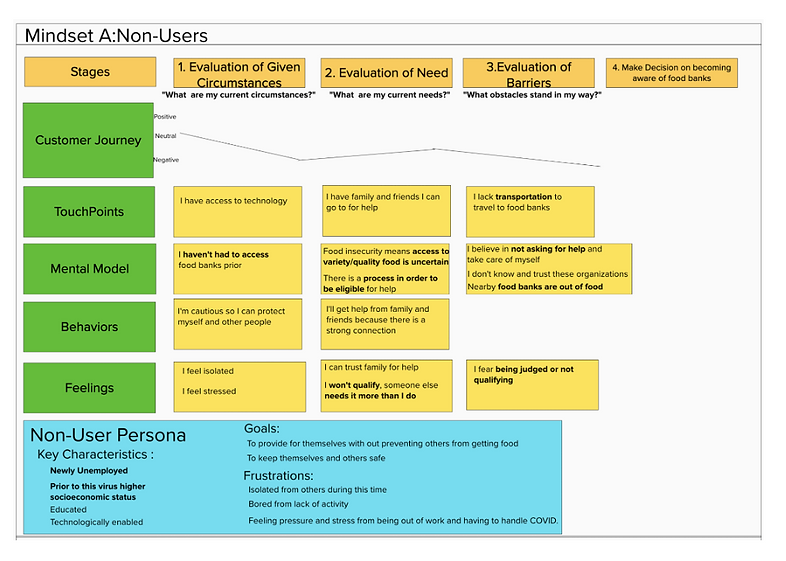
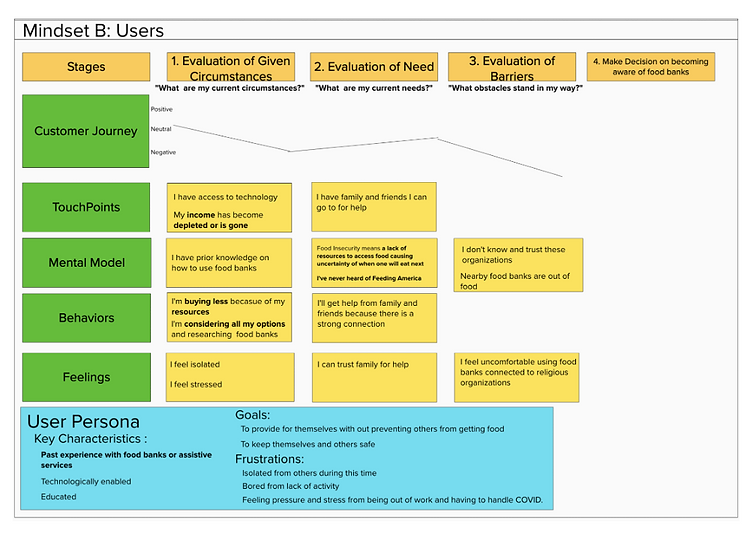
Narrative story arc like user journey map helped us visualize the process of people's awareness of Feeding America.
Thus, we could better identify the touchpoints that were helpful for ideation.
Journey Map
Design Criteria
Based on our insights and findings, we established the following design criteria that must be included for a solution to awareness and utilization of food banks:


Concept Deliverables

Concept 1: Advertisement Targeting on Unemployed Audience
-
Includes a clear definition for food insecurity as well as eligibility
-
Quick access to the necessary information
-
Simple clear language
-
Partnernship with the Unemployment office for outreach
STORYLINE
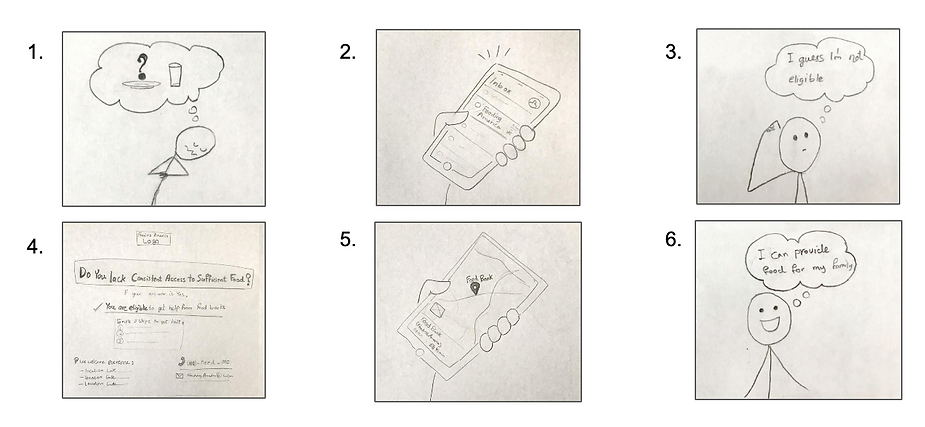
1- During COVID-19, John lost his job. He doesn't know how to provide food for himself and his family. He could not pay his bills, so he recently filed for unemployment and hasn’t heard back or received any update.
2- While waiting to hear back from the unemployment office John receives an email on his phone from the unemployment office. He sees that the subject is about a food assistance organization called Feeding America. (If John did not have access to technology this information could be mailed to him as well).
3- He is thinking only homeless people are eligible to get help from these organizations.
4- He quickly reads the information in the email related to eligibility and sees several food banks listed that are near his home.
5- John goes to lookup the location based off the email and is redirected to Google Maps that specifically highlights where the food bank is with a clear icon symbolizing the food bank. He is able to view the street view of the food bank so he knows exactly where to go.
6- He got happy because he found that he can use these services and provide food for his family.
Concept 2: Knowledge Spreading by Impactful Spokespeople via Media

-
Includes a clear definition for food insecurity as well as eligibility
-
Quick access to the necessary information
-
Simple clear language
-
TV advertisements with the help of community local leaders and celebrity spokespeople
STORYLINE
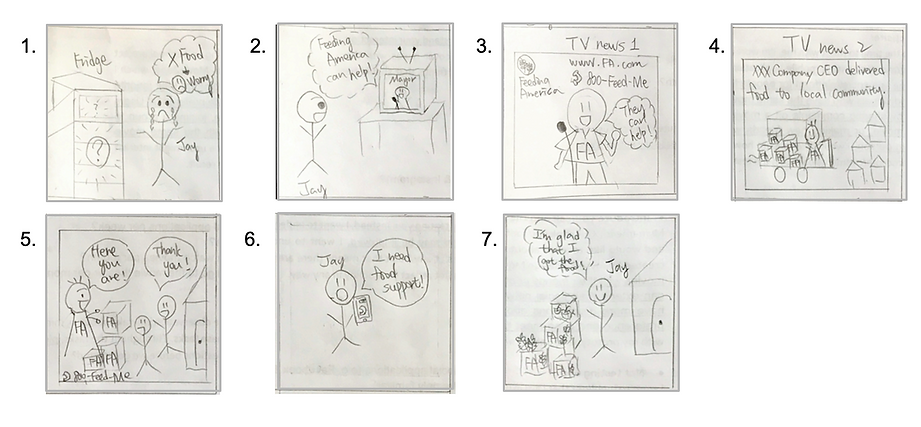
1.Jay is afraid of getting exposed to the virus during COVID-19 so he reduces the time going grocery shopping. He worries about the food resources because his income has been limited and he lives in a rural place with limited resources.
2.One day, Jay sees the mayor giving a coronavirus briefing on TV. The mayor mentions what food insecurity is and how many qualify for help.
3.The mayor says that Feeding America is an organization that can provide assistance through its nationwide food banks. During the briefing, the mayor wears Feeding America’s T-shirt, which really catches Jay’s attention.
4.The following news shows that a famous company’s CEO volunteers to help deliver food resources to the local community for those who have transportation issues in rural places.
5.The CEO delivers food packages to local resident’s houses. The food boxes with Feeding America’s logo and CEO’s T-shirt catch Jay’s eyes again.
6.Jay realizes that he is eligible for getting food support from the Mayor’s speech and he might be benefited from the delivery service. Thus, Jay contacts Feeding America to set up a food delivery based on where he is located.
7.Feeding America confirms that Jay is qualified for food support and signs him up for a delivery service. A few days later, he receives the food delivery from Feeding America with a bunch of food boxes. Jay is really happy that he has enough food for the following weeks.
Lessons We Learned
-
Be flexible: Sometimes you need to flex your audience criteria when time is limited.
-
Don’t make assumptions during the interview process: Ask follow-up questions to things that may appear obvious to get clarity.
-
People have biases, brainstorming helps in ideation when you can see things from a different perspective.
Next Steps
-
Design concepts into prototypes and test with potential users.
-
Implement concepts into tangible activities to actually increase public awareness of Feeding America.