


Job Tracking Application-JobHut
An integrated job status tracking mobile application for job seekers to better organize and follow up applied jobs efficiently
Overview
This project aims to discover an innovative approach to track job status for users who are applying for jobs from multiple platforms.
According to user researches, we recognized that the job application experience is one of the most intimidating experiences that involve a lot of uncertainty and confusion, especially at the job tracking stage. While there are multiple tools available to search and apply for a job, there is no single platform that can manage all the applied jobs at once.
By organizing all the constraints, we proposed a solution that could turn out to be the unique features for our application that set us apart from other tracking tools in the job market.
Type
Graduate Capstone Project
Skills
User Research
Sketching
Prototyping
Usability Testing
Project Management
Role
UX Designer
Project Manager
Duration
10 weeks
(Mar - Jun 2020)
Tools


Motivation
The inspiration for conducting this project began while we dissecting everyday issues with our fellow students. In the process of looking for internships, everyone from the team felt that job search experience is tedious, time-consuming, and stressful.
Problem
While there are multiple tools available to search and apply for a job through their websites, but there is no single platform that can systematically manage all the applied jobs from various job portals or company websites at once.

Problem 1
Manually updating job status on excel sheets or existing tracking tools is time-consuming and could increase job seeker's cognitive workload.
Problem 2

Landing on the dream job might be difficult because job seekers might forget to send out follow-up emails or mark the upcoming Interviews on the schedule.
Problem 3

The job-seeking process could be nerve-wracking without time control and identifying the potential problems.

Design Thinking Process
Click on the circles to view each step
Empathize
Who is the user? What matters to the audience?
Literature Review
We identified a significant relationship between employment and mental health well-being. In a review of the literature (Vemuri, 2014) states even a job seeker with significant job experience struggles to manage their job application process. (Lim et al., 2018) a study conducted with 124 university graduates from Korea identified that about 40% of the students suffered from clinical depression, and 15% percent of the students reported with suicidal initiation caused by job-seeking stress.
Interview
To identify approaches used by users to track the jobs applied, we recruited eight participants who are between the age of 24-31, and who have applied for jobs through online job portals within the last six months. After transcribing the interviews and conducting inductive coding, our team found common themes and built an affinity diagram as below.

We discovered that the vast majority of our participants use spreadsheets and email as a source for job tracking. We additionally distinguished various issues with the utilization of email for job tracking leading job seekers to feel a spectrum of negative emotions. Job tracking is indeed a stressful experience for job seekers.

Online Survey
According to the result of the online survey, 76% of the participants have used more than two job portals to apply for jobs simultaneously. 60% of the participants do keep a note of their applied jobs, while only 56% of them update their notes frequently.(Figure 1) 63% of the participants search emails to track jobs. (Figure 2)

Figure 1.

Figure 2.
Competitive Research
We did competitive research to discover the advantages and constraints of existing websites and applications
that help job seekers to track their application. Some job search websites provide their own built-in tools to keep track of the applications, such as LinkedIn, Glassdoor, Monster, and CareerBuilder. At the same time, more job search management websites (e.g. Jibber Jobber, Huntr, Job Hero) appear in order to offer assistance specifically for job hunters.
We found out that all the job management tools rely on a manual data filling process which increases the user's cognitive workload to keep track of the job application status. (See Table below)


Define
What are the user needs and challenges?
Persona & Scenario
We ask the important question, “Whom are we designing for?”
Two personas were created to understand our target users' expectations, concerns, and motivations. Moreover, we used user scenarios to visualize how users will use a product or service that can help to generate design ideas.


Ideate
What could be the possible solutions to user needs?
Sketch
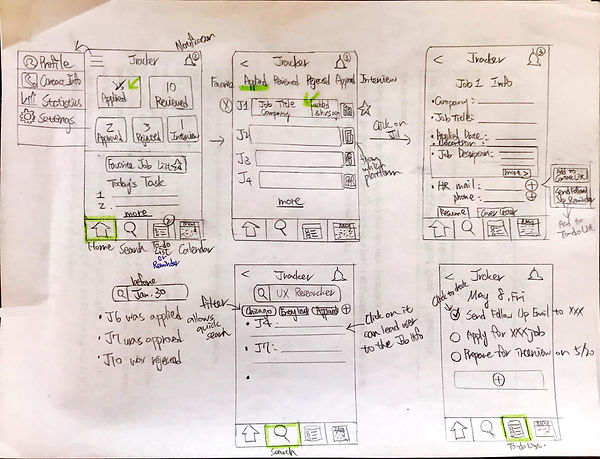
Based on user researches and brainstorming, quick and dirty sketches were created by the team at the pre-design stage.

Card Sorting
To get better clarity on target audience domain knowledge as well as to create app information architecture, we conducted two rounds of card sorting using optimal workshop tool.

Among 28 cards, lots of cards were too confusing for participants to categorize into the existing categories.

The result showed higher agreement on the 5 categories, which then became the main navigation for our app.
Among 28 cards, lots of cards were too confusing for participants to categorize into the existing categories.

Completion Rate
Increased


Completion Time
Decreased
Sitemap
Sitemap was designed based on iteration done in card sort. Apart from the original five categories i.e., Dashboard, Calendar, Settings, Profile, Notification, we added Scan and Add a job to the main navigation, which is then sub categorized in the second level page.

Challenge in the Ideation Process
Solution 1.1

We asked ourselves,
"Does our idea of syncing emails to automatically update the job status really work?"
Solution 1.2

Therefore, we came up with another feature if the user has not provided the email access, which is updating status manually by scanning job-related emails.
Second Survey
Our survey result showed that 56% of the participants mentioned that they wouldn’t give permission to an application to access their email inbox even if just to retrieve the job-related emails. (Figure 3.) The main reason is because of the privacy issue and the concern about their confidential information in their email.

Figure 3.
Design
How will the ideas be tangibly displayed? Which design really works?
Low Fidelity Wireframes

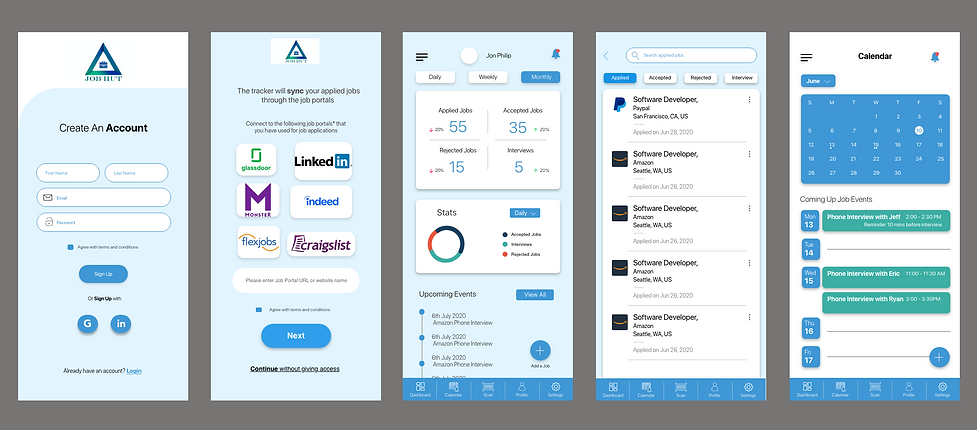
Mid Fidelity Wireframes
Test
How valuable and effective is the design solution?
Usability Test
Two rounds of usability tests were conducted by me and the team. For each test, we recruited eight participants who were above 18 years old, and who have applied for jobs through online job portals within the last six months. The tests were conducted virtually through Google Hangouts and Zoom.
For the first round, We synced job portals with our JobHut app during the onboarding process.


For the second round, we added tasks to test our features including scanning a job-related email, manually adding an applied job, and setting a reminder for a job interview on the calendar.

Design Iteration
According to the usability test results, we discovered some interesting findings. Then, I discussed with my team and we came up with the design changes as below.
Observation 1:
For the task of checking job details, one of the participants was not able to complete the task because he was confused between Applied jobs and Acknowledged jobs. Also, three of eight participants were confused between favorite jobs and Saved jobs while completing it, one of the participants asked: “What’s the difference between favorite and saved job?”


For the homepage, we focused on information that's more important for job seekers, including the overall job status and upcoming events.
The status sections on the dashboard were confusing for the users.
Therefore, we removed Favorite and Saved jobs, and renamed Acknowledgment as Accepted jobs.
Observation 2:
We observed that many of the participants were not able to find the job adding option on the dashboard page when we tested the manually adding a job function. Also, we discovered that the add a job button is required anywhere other than dashboard.


We decided to use bottom navigation for the most essential features of our application.
Put "add a job" option at the bottom navigation and moved settings, and profile to the hamburger menu.
Observation 3:
For the task of adding a reminder for an event on the calendar, we observed that most of the participants tried to click the dates on the calendar first and then clicked the add button later.

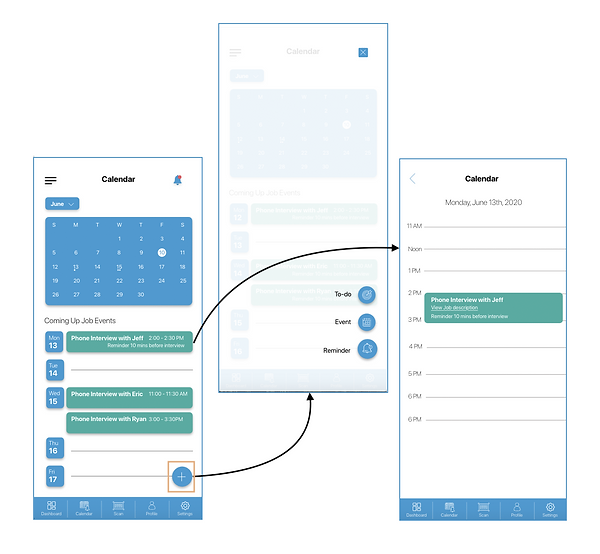
Changed dates on the calendar to be clickable and added a reminder button in the date page.
High Fidelity Prototype
After refining the design through usability testing with potential users, JobHut mobile application was presented.
Tap to interact with
the prototype


Solution

Solution 1: Automatically load the job application data.
1.1 Onboarding process for syncing emails and job portals to JobHut
1.2 Applying image recognition technology to scan job-related emails

Solution 2: A calendar specifically for scheduling job interviews and setting reminders keep users focusing on the journey of landing a dream job. Notification reminds users to send out follow-up emails.

Solution 3:
Dashboard provides job seekers an overall summary of job status based on time frames.
Statistics report shows analytic job status, which helps users to examine the job-hunting process.

Outcome
Our JubHut mobile application received positive feedback from users who have suffered tedious job tracking experience.

" The overall interface is clear and easy to navigate. "
" JobHut saves lot of time once the setup is complete. I like the calendar. It’s quite straightforward. "

However, based on the usability test results, we still found some parts of our app confusing and needed some improvements.
" This scan button is confusing …
Not sure about the statistics chart on the dashboard. "


" Are the statistics really necessary? Will it show all the history data?
I think the “number” is enough to show me the info. "
Takeaways & Future Work
Learnings:
-
Constant communication is the key. It's important to pause to make sure that everyone on the team is on the same page.
-
Not just design the features that might work but stand in users' shoes to examine the user flows and provide more info to guide users to understand our scanning and statistics function.
-
Small changes matter and they do make a difference. Changes such as enlarging the size of a button, placing a button at the right position, and renaming a tab can create a better user experience.
-
Don't be afraid of implementing innovative concepts in the design phase. Be bold to think outside the box.
-
Feedback from users is valuable that could inspire designers with new ideas.
More features that can be implemented in our JobHut app:
-
Provide resumes and cover letters scan and save options.
-
Allow the users to practice for job interviews using VR.
-
Focus on the Hofstede’s Dimensions of Cultural Difference to customize the JobHut app for job seekers in diverse countries.